IPL Photofacial in Clovis, NM: What It Treats, How It Works, and Whether It's Right for You
TL;DR: IPL photofacial uses broad-spectrum light to target pigmentation, redness, and sun damage in the skin without breaking the surface, making it a no-downtime option for patients dealing with the photoaging effects of Eastern New Mexico's high-UV climate. At Main Street Med Spa in Clovis, IPL is one of several laser and light treatments at Main Street Med Spa in Clovis selected based on your specific skin concerns.
If you've lived in Clovis or anywhere across Curry County for more than a few summers, your skin has a record of it. Sun spots that showed up in your thirties. Redness across the cheeks that never quite goes away. A general dullness that no amount of skincare seems to fix. These are the visible effects of cumulative UV exposure, and Eastern New Mexico's clear skies and high elevation mean residents get more sun intensity than most parts of the country realize.
IPL photofacial Clovis NM patients ask about most often is the one that addresses exactly this kind of damage, without surgery, needles, or recovery time. This guide covers what IPL actually does, what it can and can't treat, how many sessions it takes, and how it compares to other laser options available at Main Street Med Spa.
What Is IPL Photofacial and How Does It Work?
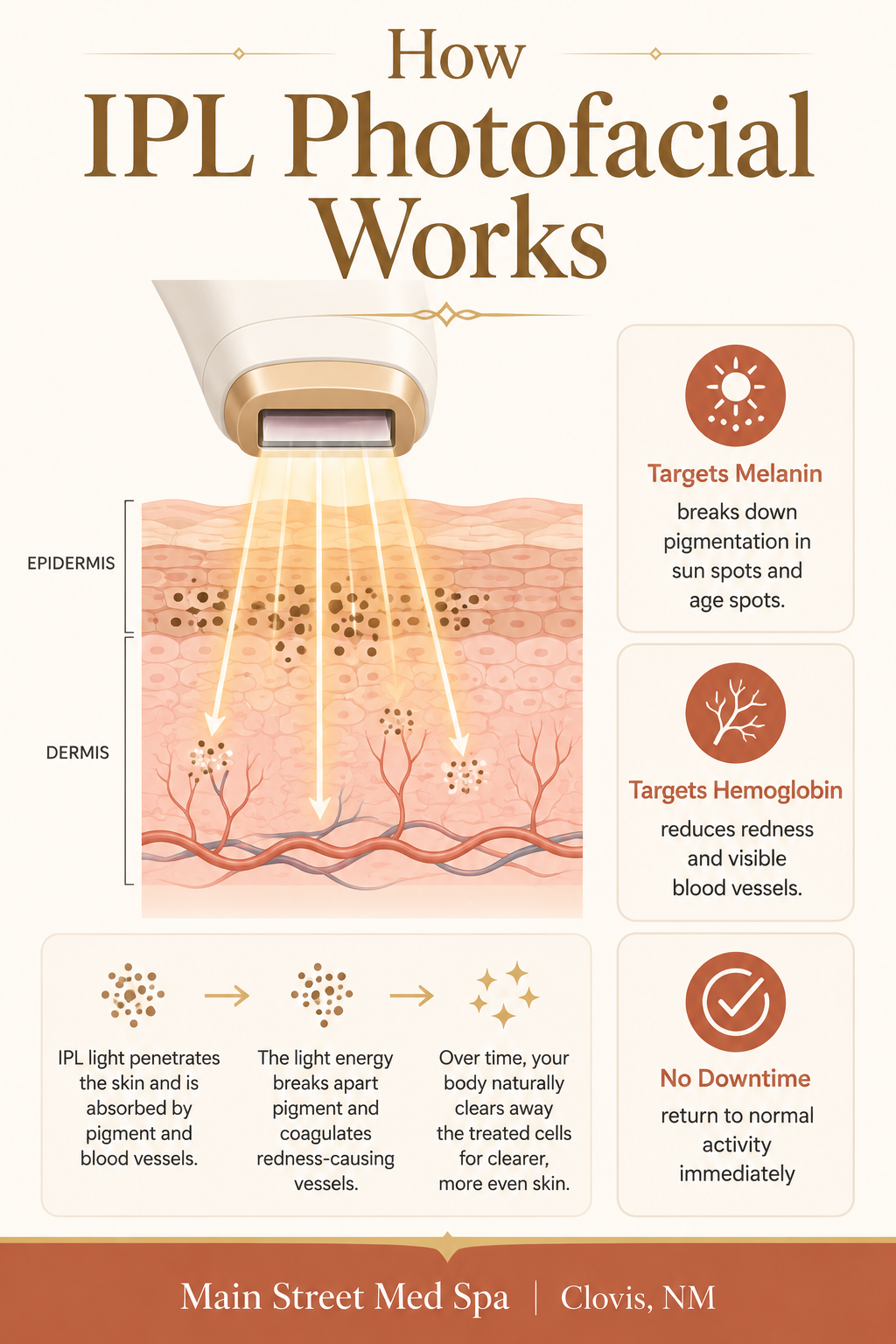
IPL, or intense pulsed light, delivers broad-spectrum light energy into the skin, where it's absorbed by melanin (pigmentation) and hemoglobin (blood vessels). That absorption causes targeted damage to the unwanted cells, which the body then clears naturally over the days following treatment.
Despite the name, IPL treatment Clovis NM providers use isn't technically a laser. A traditional laser emits a single, focused wavelength of light. IPL emits multiple wavelengths at once, in a broad spectrum, which is why it's effective against several different concerns in the same session: pigmentation, redness, and mild vascular issues all respond to different parts of that spectrum.
IPL vs. Laser: The Technical Difference
A laser is precise and singular. IPL is broad and versatile. That difference matters clinically because a single IPL session can address sun spots and diffuse redness in the same pass, where a true laser typically needs to be matched to one specific target. It's part of why IPL has remained a staple treatment for general photoaging rather than one narrow concern.
What Happens to Your Skin During and After Treatment
During treatment, a cooled handpiece glides across the skin while pulses of light are delivered. Most patients describe the sensation as a mild snap, similar to a rubber band against the skin. There's no cutting, no needles, and no anesthesia required.
Afterward, treated pigment typically darkens over the following three to five days before flaking off on its own. This is expected and is part of how the skin clears the damaged cells. Redness may also temporarily intensify before improving.
What Skin Concerns Does IPL Treat Effectively?
IPL is most effective for sun spots, freckles, diffuse redness, rosacea, broken capillaries, and mild overall dullness from photoaging, which makes it particularly relevant for anyone who has spent years under Eastern New Mexico's intense, near-constant sun.
Sun Damage and Pigmentation
Years of UV exposure produce uneven pigmentation that builds slowly and rarely fades on its own. IPL targets that pigment directly, breaking it down so the body can clear it. Patients are often surprised at how much clearer and more even their skin tone looks once years of accumulated spots are addressed.
Redness and Rosacea
Diffuse redness across the cheeks, nose, and chin often comes from visible or near-surface blood vessels. IPL's light energy is absorbed by hemoglobin in those vessels, causing them to collapse and fade. Patients with rosacea frequently see meaningful improvement in both color and texture after a series of sessions.
Where IPL Has Limitations
IPL works at the surface. It does not resurface skin texture, tighten the skin, or significantly soften deep fine lines, because it isn't designed to stimulate the same level of structural collagen response as an ablative treatment. Patients whose primary concern is texture, not color, typically need a different approach. This is where
how CoolPeel compares to IPL for deeper skin resurfacing becomes a useful comparison, since the two treatments solve different problems.
How Many IPL Sessions Do Most Patients Need?
Most patients need a series of three to five IPL sessions spaced three to four weeks apart to achieve full correction of existing sun damage. Maintenance sessions once or twice a year then help manage new pigmentation from ongoing sun exposure.
The exact number depends on how much damage has accumulated and how the skin responds to early sessions. Patients with mild, isolated concerns sometimes see strong results in two sessions. Patients with decades of sun exposure, which is common among longtime Clovis and Portales residents, often benefit from the full series to get the most thorough clearance. Because IPL works gradually as the body clears treated cells, results build session over session rather than appearing all at once.
How Does IPL Compare to CoolPeel for Sun-Damaged Skin?
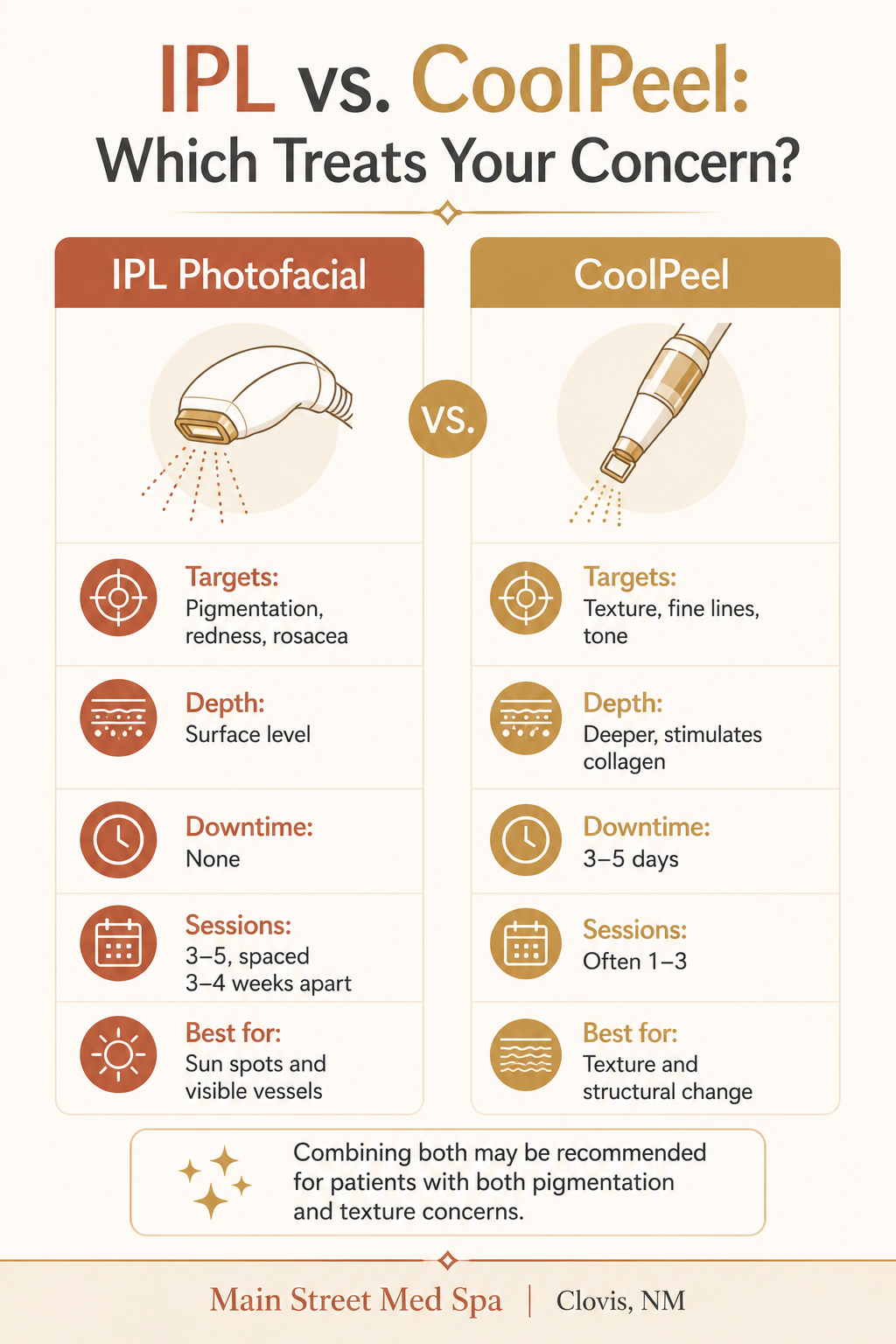
IPL targets surface pigmentation and vascular concerns with no downtime, while CoolPeel resurfaces the skin's physical texture and stimulates collagen at a deeper level, requiring three to five days of recovery. The right choice depends on whether your primary concern is pigmentation, texture, or both.
When to Choose IPL
If your main concern is color, sun spots, redness, or rosacea, and you want zero downtime, IPL is generally the better starting point. It fits easily into a normal schedule and requires no recovery period.
When to Choose CoolPeel
If your concern is texture, fine lines, enlarged pores, or overall skin tightening, CoolPeel goes deeper and produces more structural change. It requires a short recovery window of three to five days but delivers results IPL isn't designed to produce.
When Combining Both Makes Clinical Sense
Many patients in Clovis have both pigmentation and texture concerns after years of sun exposure, and combining the two treatments in a planned sequence often produces a more complete result than either alone. Madison Alcaz, RN BSN, evaluates which order and spacing makes sense for each patient's skin and goals during the initial consultation.
Who Is Not a Good Candidate for IPL?
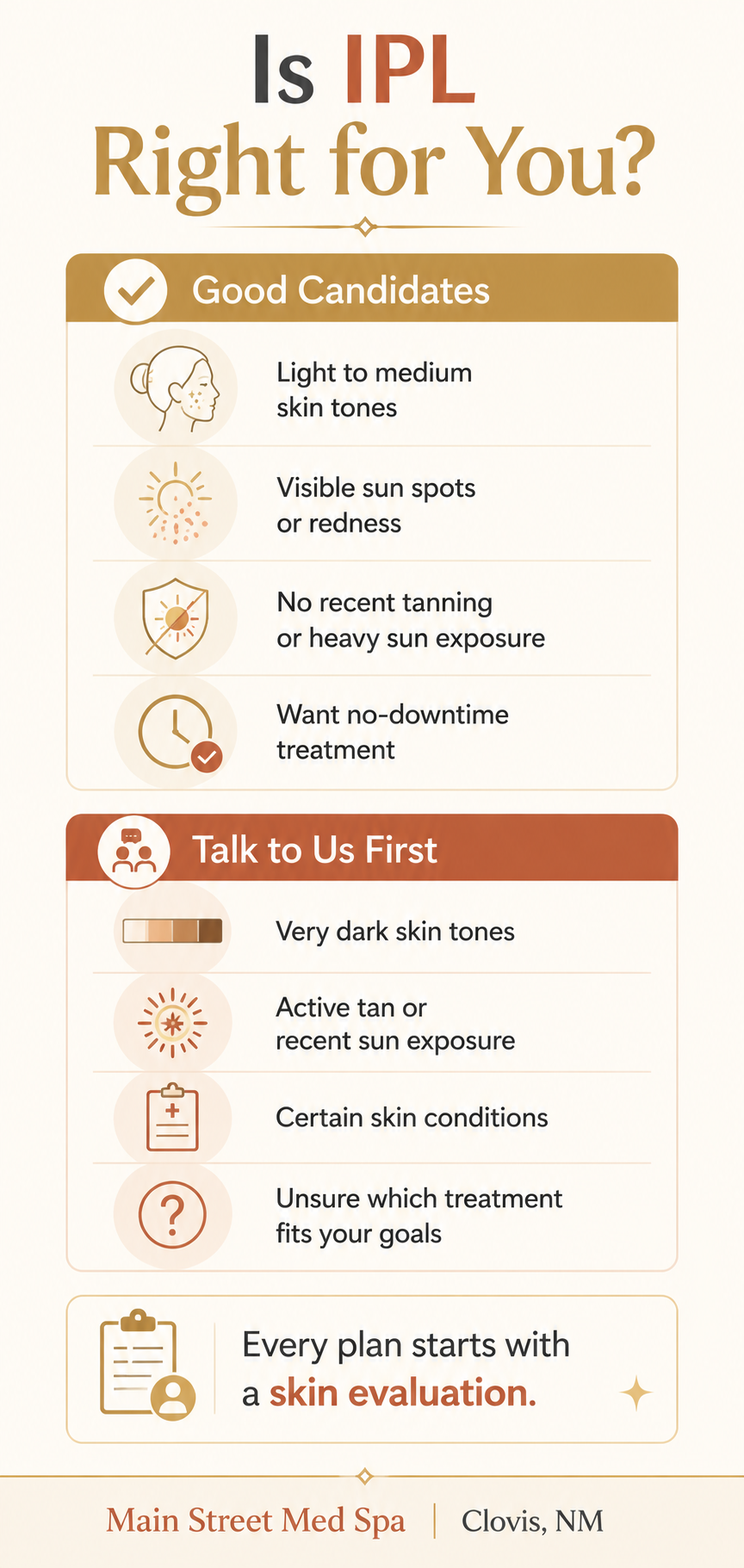
IPL is not recommended for patients with very dark skin tones, recent heavy sun exposure, an active tan, or certain underlying skin conditions. A skin evaluation with Madison Alcaz, RN BSN, determines candidacy before any treatment is scheduled.
This matters because IPL works by distinguishing pigment in a sun spot from the surrounding skin, and on darker skin tones that distinction becomes harder for the light energy to make safely. Patients concerned about how their skin tone factors into treatment selection can learn more about
how skin tone affects laser and IPL treatment selection, since not every laser or light treatment is appropriate for every complexion.
How Do You Get Started With IPL at Main Street Med Spa in Clovis?
IPL patients begin with a skin evaluation and consultation to assess skin type, tone, and the nature of their pigmentation or vascular concerns, ensuring the treatment is both safe and properly calibrated. There's no standard protocol applied across every patient. Every plan starts from what your skin is actually showing.
Frequently Asked Questions About IPL Photofacial
What does IPL photofacial treat?
IPL photofacial effectively treats sun spots, age spots, freckles, diffuse redness, rosacea, broken capillaries, and overall dullness from photoaging. It works by delivering broad-spectrum light into the skin that targets melanin and hemoglobin, prompting the body to clear the damaged cells naturally. It's particularly effective for patients with significant UV exposure history, common across Eastern New Mexico.
Is there downtime after IPL?
IPL is considered a no-downtime treatment. Treated pigment spots typically darken over the three to five days following treatment before flaking off naturally, which is a normal part of the clearance process. Most patients return to regular activity immediately. Sun protection right after treatment is essential.
How many IPL sessions will I need?
Most patients require three to five sessions spaced three to four weeks apart for full correction of established sun damage. Patients with mild concerns may see significant improvement in two sessions. Your recommended series is determined during your skin evaluation at Main Street Med Spa.
How does IPL compare to CoolPeel laser resurfacing?
IPL targets pigmentation and vascular concerns at the surface with no downtime. CoolPeel resurfaces the skin's physical texture and stimulates deeper collagen production, treating fine lines and texture that IPL cannot reach. Patients with both pigmentation and texture concerns often benefit from a combination approach, which Madison Alcaz, RN BSN, designs during consultation.
Is IPL safe for all skin tones?
IPL is most effective and safest on lighter to medium skin tones. It's generally not recommended for very dark skin tones or patients with an active tan, since broad-spectrum light may not differentiate well between pigmentation targets and surrounding skin. Skin type is assessed during consultation to determine the safest, most effective option.
Madison Alcaz, RN BSN's Perspective
"Eastern New Mexico gives us exceptional light, and exceptional UV exposure along with it. I see the cumulative effects in patients who have lived here their whole lives. Sun spots that have been there so long they feel permanent. Redness that gets dismissed as just how their skin is. IPL is one of the most satisfying treatments to perform, because patients often can't believe what their skin looks like underneath the damage. It was there the whole time."
— Madison Alcaz, RN BSN
Ready to Address Sun Damage Before Peak Summer Months?
Summer UV exposure adds new pigmentation every season, so addressing existing sun damage before peak sun months helps preserve your results longer. Putting it off means treating more damage later, not less.
At Main Street Med Spa, every IPL plan starts with a full skin evaluation with Madison Alcaz, RN BSN, who brings more than 10 years of experience to every consultation. There's no generic protocol. Your session count and treatment plan are built around your skin, your sun history, and your goals, whether you're coming from Clovis, Portales, Texico, or anywhere across Curry and Roosevelt County.
Explore the full range of
laser and light treatments at Main Street Med Spa in Clovis and schedule your IPL skin evaluation to find out what your skin looks like underneath years of sun exposure.
IPL photofacial in Clovis, NM offers a no-downtime way to reverse years of sun damage and redness, and the right approach starts with a proper evaluation, not a one-size protocol. For patients across Eastern New Mexico's high-UV climate, that evaluation is the difference between guessing and a plan built for your skin.