Tirzepatide for Medical Weight Loss in Clovis, NM: What a Supervised Program Actually Looks Like
TL;DR
- Tirzepatide is a dual GLP-1/GIP receptor agonist that suppresses appetite and supports metabolic health, producing significant average weight loss in clinical studies.
- A supervised program at Main Street Med Spa in Clovis, NM includes health history review, baseline labs, individualized dose titration, and ongoing monitoring by Madison Alcaz, RN BSN.
- Results vary by patient, but the structure of the program, not just the medication, is what makes outcomes sustainable.
If you've spent any time researching weight loss options in Clovis, you've probably noticed how many ways there are to get a GLP-1 prescription now. Telehealth companies will ship it to your door. Compounding pharmacies will sell it without ever reviewing your full medical history. None of that is the same as a supervised Tirzepatide weight loss program built around your labs, your health history, and how your body actually responds week to week.
At Main Street Med Spa, Tirzepatide is administered as part of a structured medical weight loss program, not a one-time prescription handed off and forgotten. Madison Alcaz, RN BSN, reviews each patient's candidacy, sets a titration schedule based on individual tolerance, and stays involved through every phase of treatment. For patients across Clovis, Portales, and the wider Eastern New Mexico region, that oversight is the difference between a medication and a program with a plan behind it.
This guide walks through how Tirzepatide works, who it's appropriate for, what the program actually involves week to week, and what realistic results look like.
How Do You Start a Tirzepatide Program in Clovis, NM?
The first step is a medical weight loss consultation with Madison Alcaz, RN BSN at Main Street Med Spa. Your health history, goals, and candidacy are reviewed before any program is recommended, so you know exactly what to expect before committing to anything.
Patients who start their program earlier in the year tend to have more runway to reach a goal weight and move into a stable maintenance phase, rather than starting and stopping partway through. If you've been considering a supervised approach to Tirzepatide, your consultation is where that conversation actually starts, with real labs and a real plan instead of a subscription form.
Main Street Med Spa serves patients throughout Clovis, Portales, Texico, Farwell, Roosevelt County, and the broader Eastern New Mexico region. Every program is overseen by Madison Alcaz, RN BSN, with more than 10 years in practice and extensive training in aesthetics and medical wellness, which means your
medical weight loss program in Clovis, NM is built around your bloodwork and your response, not a generic protocol. Hormone balance can also play a role in weight loss outcomes, which is something we evaluate when relevant. Learn more about
how hormone balance affects weight loss outcomes.
What Is Tirzepatide and How Does It Work for Weight Loss?
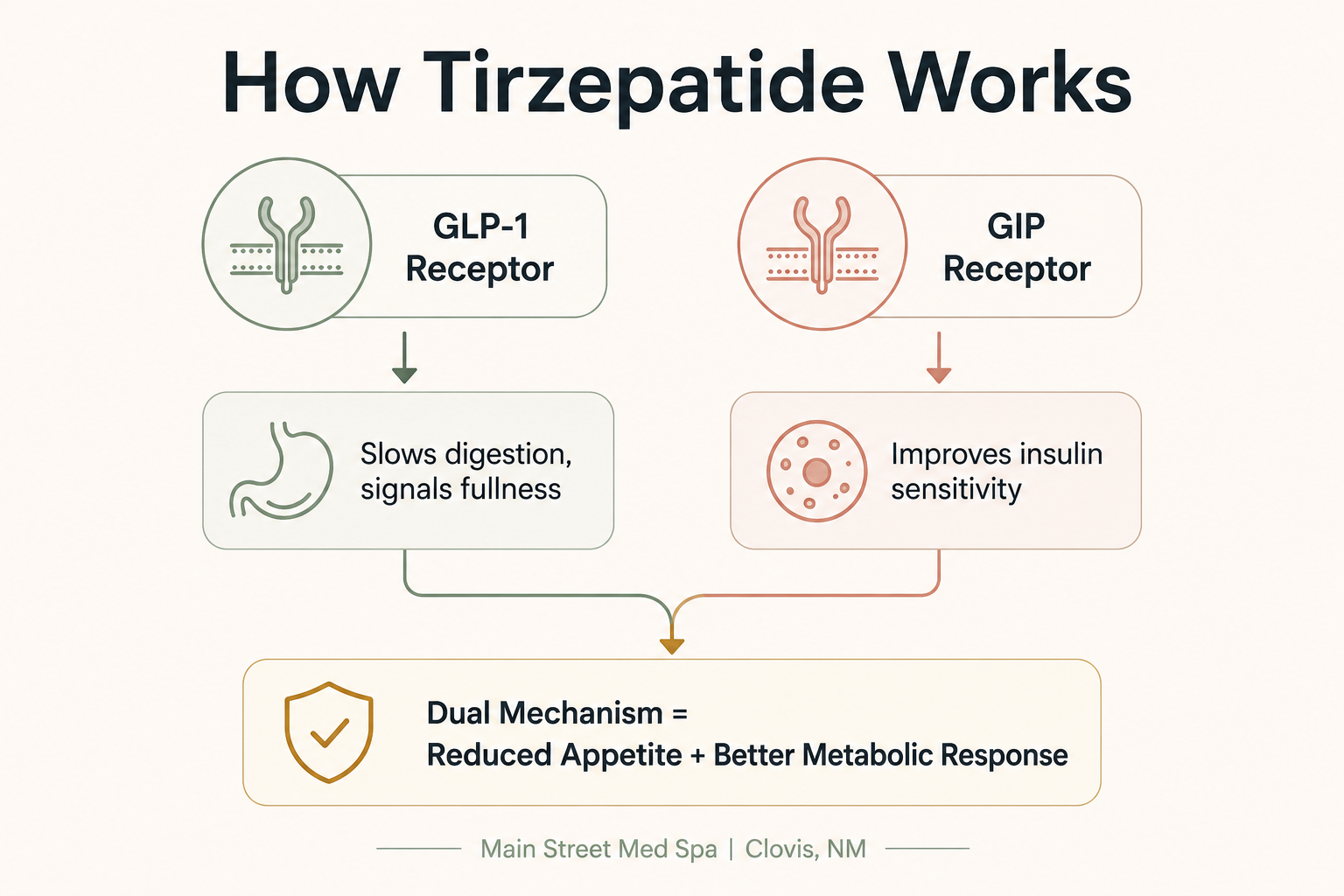
Tirzepatide activates both GLP-1 and GIP receptors, which reduces appetite, slows gastric emptying, and improves insulin sensitivity. That dual mechanism is what separates it from older GLP-1-only medications and is part of why it has shown stronger average weight loss results in clinical trials.
GLP-1 (glucagon-like peptide-1) is the hormone most people associate with this category of medication. It signals fullness to the brain and slows how quickly food leaves the stomach. GIP (glucose-dependent insulinotropic polypeptide) works alongside it, supporting insulin response and playing its own role in appetite regulation. Activating both receptors at once, rather than just one, appears to produce a more complete metabolic effect.
GLP-1 vs. GIP: what the dual mechanism means. Acting on a single pathway can still suppress appetite effectively, which is how earlier medications like semaglutide work. Adding the GIP pathway gives Tirzepatide a second point of influence on insulin sensitivity and energy regulation, which is part of why head-to-head trial data has shown a meaningfully higher average percentage of body weight lost with Tirzepatide.
How Tirzepatide differs from semaglutide (Ozempic/Wegovy). Semaglutide activates GLP-1 receptors only. Tirzepatide activates both GLP-1 and GIP receptors. In practice, many patients who didn't see the results they wanted on a GLP-1-only medication are candidates for Tirzepatide instead, though that decision should always be made during a consultation, not self-directed.
Who Is a Good Candidate for Tirzepatide at Main Street Med Spa?
Candidates are typically adults with a BMI of 27 or higher who also have a weight-related health condition, or a BMI of 30 or higher on its own, who haven't reached their goals through diet and exercise alone. Candidacy also depends on having no contraindications to GLP-1 therapy, which is confirmed through a full medical review before any prescription is written.
That review is not a formality. It's the part of the process that catches the details a telehealth questionnaire usually misses.
Medical history review and lab work. Before starting Tirzepatide, patients complete a full health history with Madison Alcaz, RN BSN, covering current medications, prior weight loss attempts, thyroid history, and any GI conditions. Baseline labs help establish a starting point for metabolic health and confirm there's nothing that needs to be addressed before treatment begins.
Conditions that require additional evaluation. A personal or family history of medullary thyroid carcinoma or MEN2 syndrome rules out GLP-1 therapy entirely. Patients with a history of pancreatitis, significant GI disease, or who are pregnant or breastfeeding also require additional evaluation or are not candidates. This is exactly the kind of detail that gets missed in a five-minute online intake form, and exactly why RN oversight matters from the first visit.
What Does the Tirzepatide Program at Main Street Med Spa Look Like?
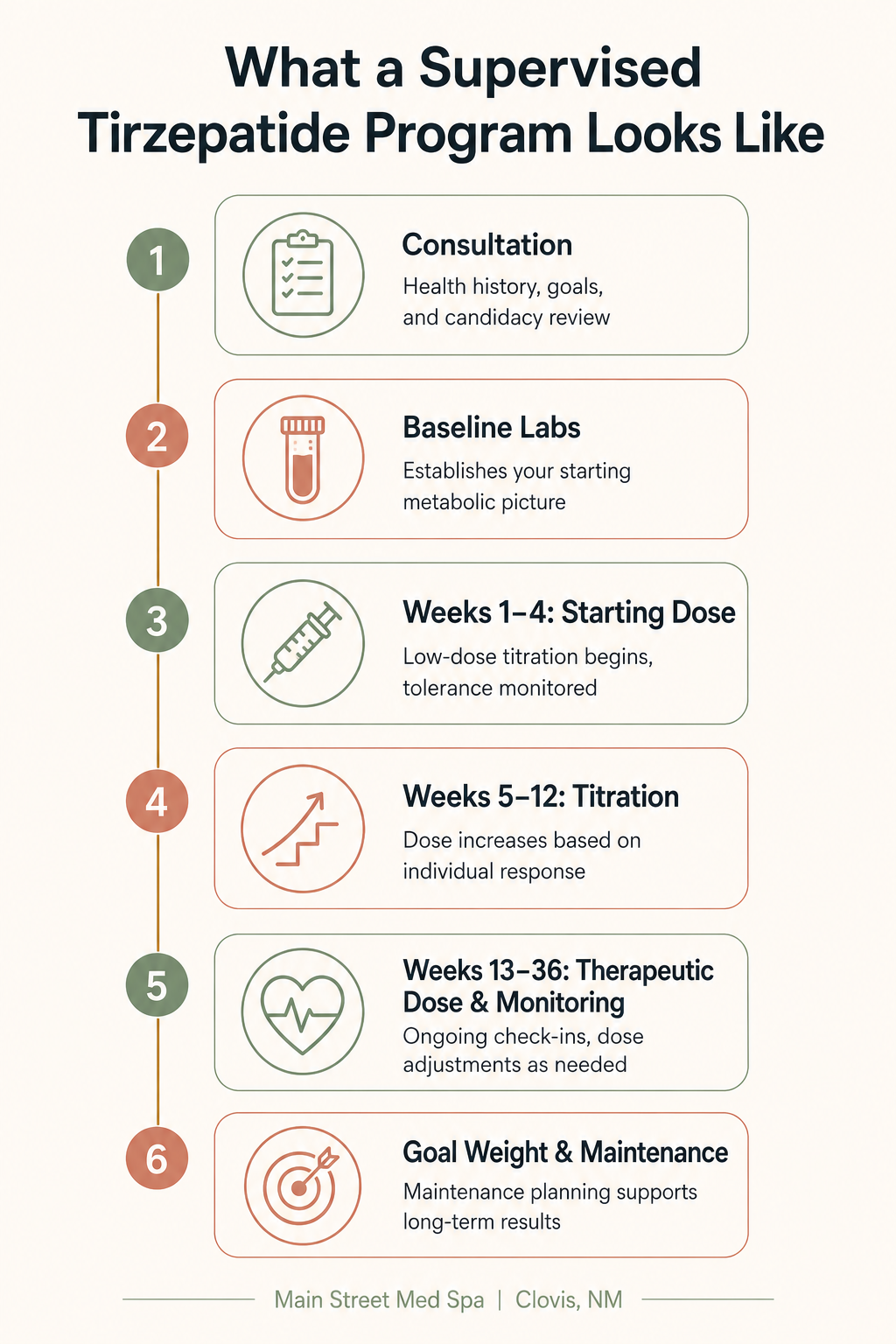
The program starts with a full consultation, health history review, and baseline labs, then moves into a dosing schedule that's titrated upward based on your individual tolerance and response, not a fixed protocol applied to every patient the same way.
The consultation and onboarding process. Your first visit covers goals, health history, current medications, and any past experience with weight loss medications. Madison Alcaz, RN BSN walks through what the program involves, sets expectations, and reviews lab results before any medication is started. Nothing is prescribed on the first visit without that full picture in place.
Dosing schedule and titration. Tirzepatide starts at a low dose, typically 2.5mg weekly, and increases gradually over several weeks. The pace of that increase depends on how you're tolerating the medication, not a calendar. Patients who experience more pronounced side effects may stay at a given dose longer before moving up. Patients tolerating it well may progress on a standard schedule. This is the part of the process that's hardest to get right without a clinician actively involved.
Ongoing monitoring and check-ins. Regular check-ins track weight trends, side effects, and how you're responding overall. Adjustments to dose or pacing happen based on that data, which is the core difference between a supervised program and a prescription refilled automatically every month with no one reviewing how it's actually going.
What Results Can You Realistically Expect From Tirzepatide?
Clinical trials show average weight loss of 15 to 20 percent of body weight over 72 weeks at therapeutic doses. Individual results depend on starting weight, adherence, diet, and activity level, and realistic expectations specific to your situation are set during your consultation rather than promised upfront.
Timeline of results. Appetite suppression is often noticeable within the first one to two weeks. Visible weight loss typically begins in the four to eight week range, with the most significant changes occurring between weeks 12 and 36 as therapeutic doses are reached and sustained. The 72-week mark referenced in clinical literature reflects a full course of treatment, not a guarantee for every patient.
What happens when you reach your goal weight. Reaching a goal weight isn't the end of the conversation. Maintenance planning, whether that means a lower maintenance dose, a transition plan, or continued monitoring, is part of the program from the start. Patients who stop treatment abruptly without a plan are more likely to see weight regain, which is why this phase gets built into your program rather than treated as an afterthought.
What Are the Side Effects and How Are They Managed?
The most common side effects, including nausea, mild GI discomfort, and reduced appetite, are most noticeable during dose escalation and typically ease as your body adjusts. RN oversight means your dose can be adjusted in real time if side effects become disruptive, rather than waiting weeks for a response.
Side effects tend to cluster around dose increases rather than appearing randomly throughout treatment. That pattern is part of why titration speed matters so much. Patients managed too aggressively are more likely to experience side effects severe enough to stop treatment altogether, which defeats the purpose of starting in the first place. A program built around your actual response, rather than a fixed schedule, is designed specifically to avoid that outcome.
Why Does Medical Supervision Matter for GLP-1 Weight Loss Programs?
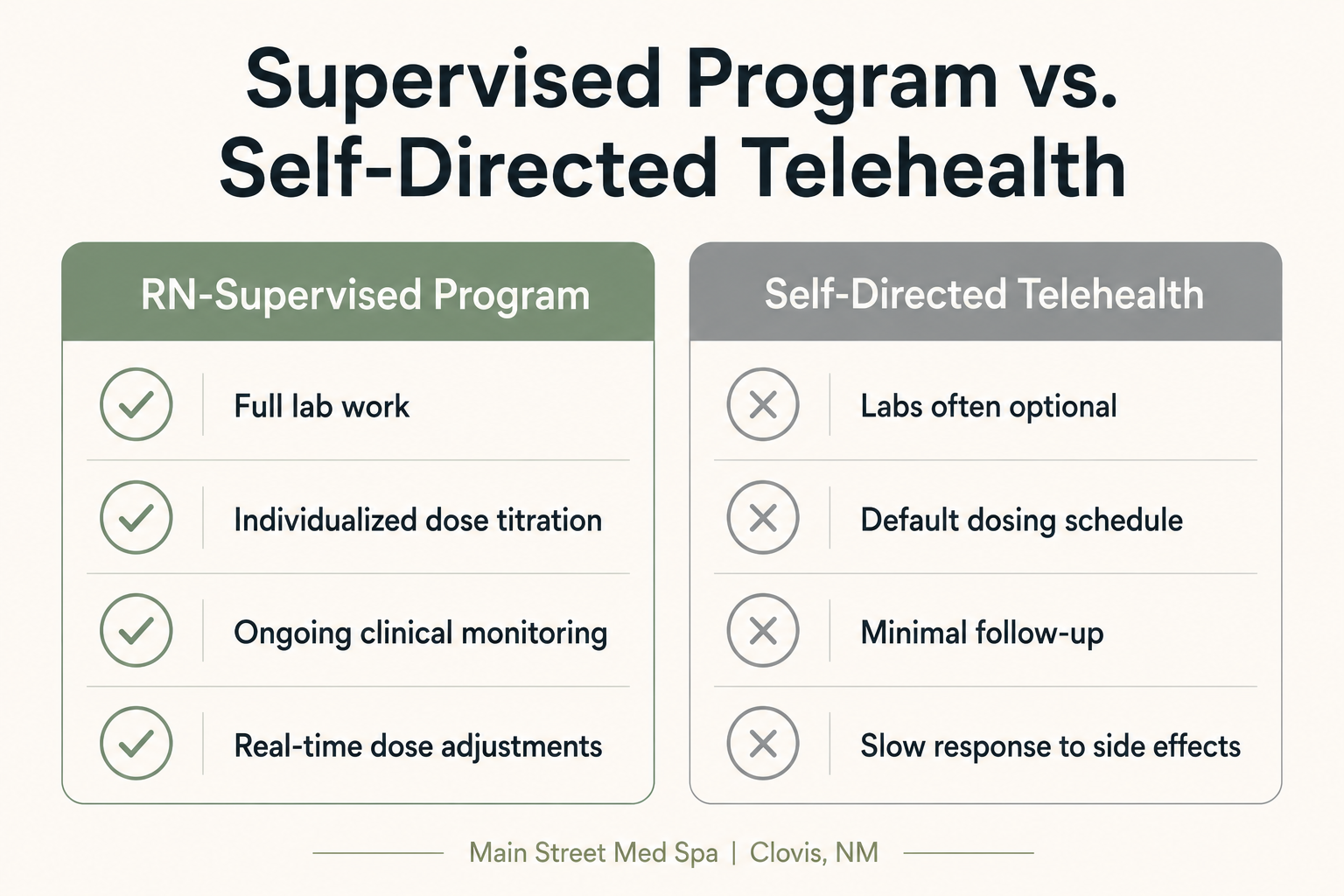
Telehealth-only and compounding pharmacy programs provide the medication itself, but typically skip the clinical oversight that catches contraindications, monitors metabolic response, and adjusts dosing as your body changes. RN-supervised programs add the accountability and safety checks that self-directed programs generally don't include.
This distinction matters more than most patients realize until they've already experienced the gap. A subscription-based telehealth model is built around volume, not individualized response. Lab work may be optional. Dose increases may follow a default schedule regardless of how a patient is tolerating treatment. A supervised Tirzepatide weight loss program in Clovis is structured the opposite way, with decisions driven by what's actually happening in your bloodwork and your week-to-week response, not a default protocol.
Frequently Asked Questions About Tirzepatide Weight Loss
What is Tirzepatide and how does it cause weight loss?
Tirzepatide is a dual GLP-1 and GIP receptor agonist administered as a weekly subcutaneous injection. It works by reducing appetite, slowing digestion, and improving insulin sensitivity. In clinical trials, it produced average weight loss of 15 to 20 percent of body weight, more than earlier GLP-1 medications. It's available through medically supervised programs like the one at Main Street Med Spa in Clovis, NM.
How much does Tirzepatide cost per month?
Monthly cost depends on dose, whether brand-name or compounded Tirzepatide is used, and how the program is structured. Full pricing is covered during your consultation with Madison Alcaz, RN BSN. See
what a supervised Tirzepatide program costs in Clovis.
How long does it take to see results with Tirzepatide?
Most patients notice appetite suppression within the first one to two weeks. Meaningful weight loss is typically visible within four to eight weeks, with the most significant results occurring between weeks 12 and 36 as therapeutic doses are reached. "In my experience, the patients who stick with the plan through the early weeks are the ones who see the most consistent results later on," says Madison Alcaz, RN BSN.
Is Tirzepatide safe?
Tirzepatide is FDA-approved for weight management and has an established safety profile in clinical trials. It isn't appropriate for patients with a personal or family history of medullary thyroid carcinoma or MEN2. A full health history review is conducted before any prescription is issued at Main Street Med Spa.
What's the difference between a supervised program and ordering GLP-1s online?
A supervised program includes medical history review, lab work, dose titration based on your actual response, and ongoing monitoring by a licensed clinician. Online or telehealth-only programs often skip these steps, meaning contraindications may go undetected and dosing may not be adjusted appropriately. "I'm overseeing every patient's program from day one, not just signing off on a refill," notes Madison Alcaz, RN BSN.
Madison Alcaz, RN BSN's Perspective
"What I see in patients who come to us after trying a telehealth GLP-1 program on their own is that they've often been on a starting dose far too long, or they've escalated too quickly and dropped off because the side effects were unmanageable. Titration isn't one-size. Your body's response tells me how to move forward. That's what supervision actually means. I'm reading how you're doing and adjusting accordingly, not just refilling a prescription."
— Madison Alcaz, RN BSN
Ready to Talk About a Supervised Weight Loss Plan?
If you've been hesitant about starting Tirzepatide because you're not sure your dosing will actually be managed correctly, that hesitation is reasonable, and it's exactly what a supervised program is built to address. Your consultation with Madison Alcaz, RN BSN includes a full health history review, candidacy assessment, and a clear walkthrough of what your program would look like before you commit to anything.
Main Street Med Spa proudly serves Clovis with an RN-supervised, individualized approach to medical weight loss. No one-size protocol, no autopilot refills, just clinical monitoring throughout your entire program.