CoolPeel vs. CO2 Laser vs. Halo: The Complete Comparison for Resurfacing Patients
TL;DR
- CoolPeel, traditional CO2 laser, and Halo are three resurfacing technologies, each striking a different balance between results and downtime.
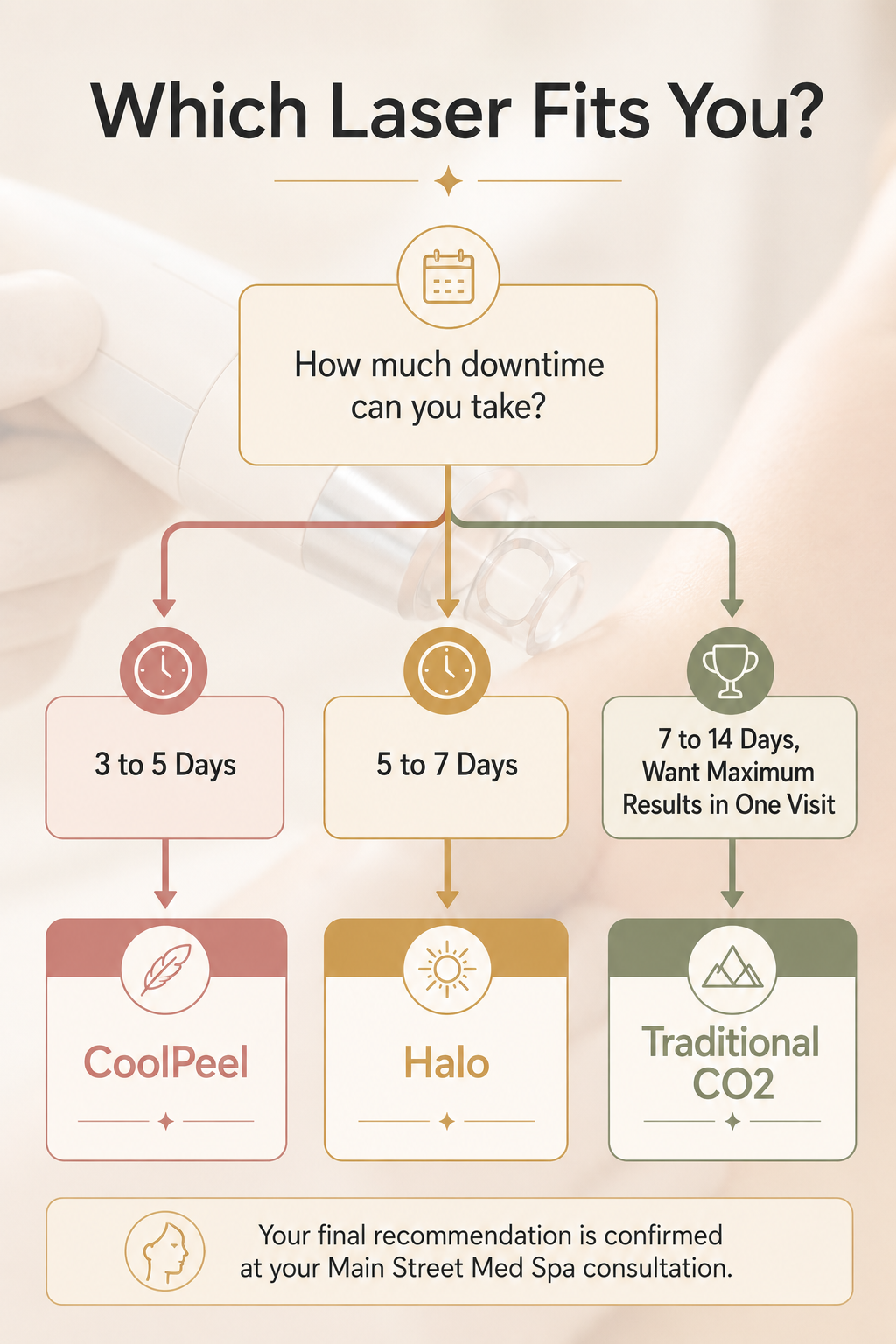
- CoolPeel delivers fractional CO2 resurfacing with a shorter recovery window, typically 3 to 5 days.
- Traditional CO2 goes deeper and asks for 7 to 14 days of downtime in exchange for stronger single-session results.
- Halo combines non-ablative and ablative wavelengths in one pass, landing in the middle at roughly 5 to 7 days.
- The right choice comes down to your skin concerns, your skin tone, and how much recovery time you can take.
If you have spent any time comparing CO2 laser downtime vs CoolPeel, you already know the research gets confusing fast. Every clinic describes these treatments a little differently, and the marketing rarely tells you what recovery feels like on day three. Sun exposure adds up for anyone living in Clovis and across Eastern New Mexico, so resurfacing questions come up often and deserve straight answers.
This guide breaks down CoolPeel, traditional CO2 laser, and Halo side by side: how each works, what downtime looks like day by day, which produces the most dramatic result, and which suits sun-damaged or higher melanin skin best. By the end, you will know which conversation to have at your consultation.
What Are CoolPeel, CO2 Laser, and Halo, and How Are They Different?
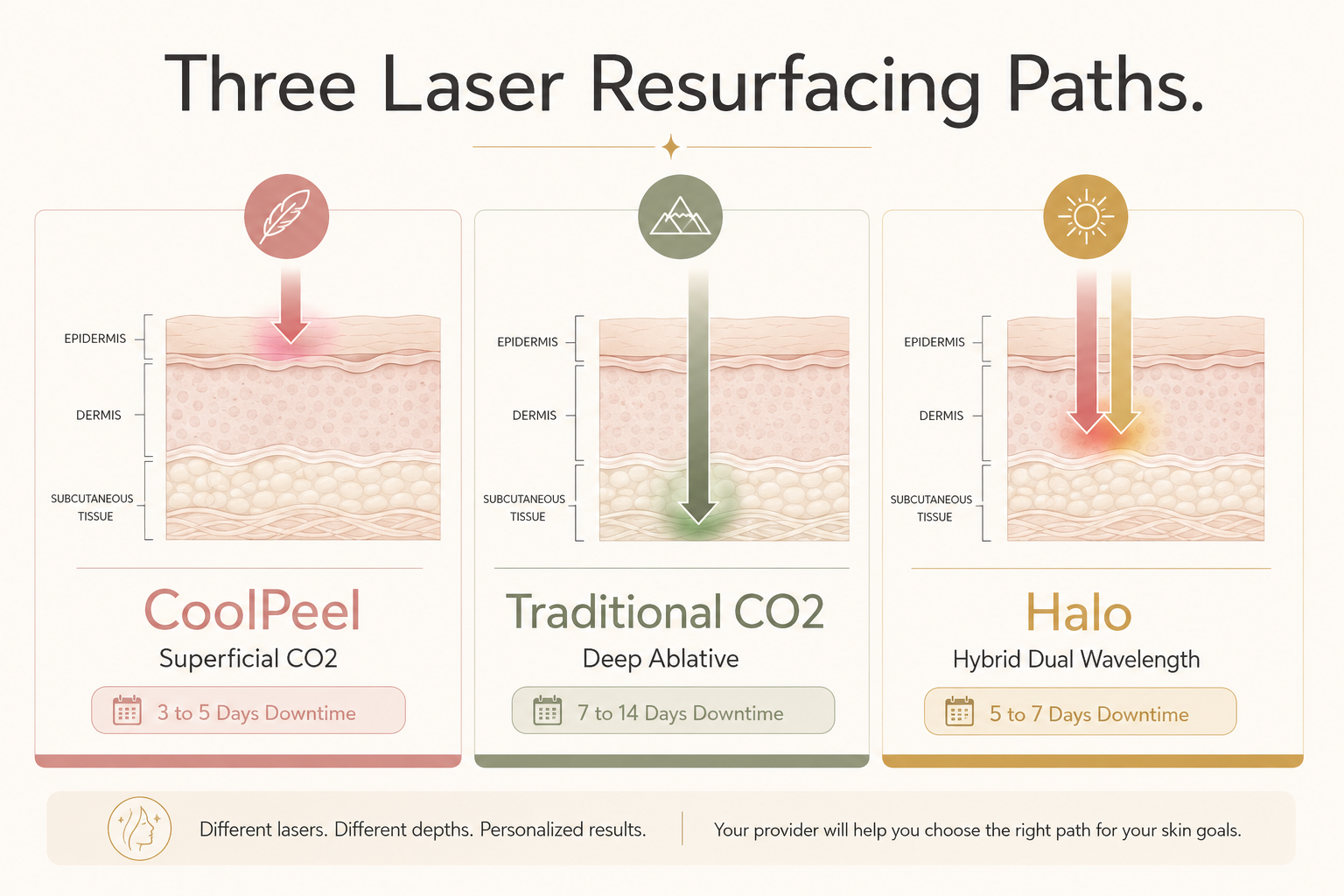
All three are laser-based resurfacing treatments, but they differ in how deeply they penetrate the skin, what wavelengths they use, and how aggressively they create the controlled injury that triggers collagen remodeling. Depth and intensity separate a weekend recovery from a two week one.
CoolPeel: Fractional Superficial CO2
CoolPeel uses a CO2 laser set to deliver energy only to the outermost layer of skin, in short high powered pulses that limit heat buildup in deeper tissue. That precision keeps recovery short while still triggering real collagen response. Patients researching this option further can read our complete guide to CoolPeel laser resurfacing in Clovis for a full breakdown of how the treatment is performed.
Traditional CO2 Laser: Full Ablative or Deep Fractional
A traditional CO2 laser can be run at full ablative settings or a deeper fractional pattern, both of which remove more tissue and reach further into the dermis. That extra depth produces a more dramatic single treatment result, and it is exactly why the skin needs longer to heal.
Halo: Hybrid Non-Ablative and Ablative Dual Wavelength
Halo fires two wavelengths at once, one non-ablative and one ablative, treating surface pigmentation and deeper texture in a single pass. It is a different mechanism from CoolPeel or traditional CO2, which is why its downtime and candidacy profile fall somewhere between the two.
How Do the Downtime Requirements Compare?
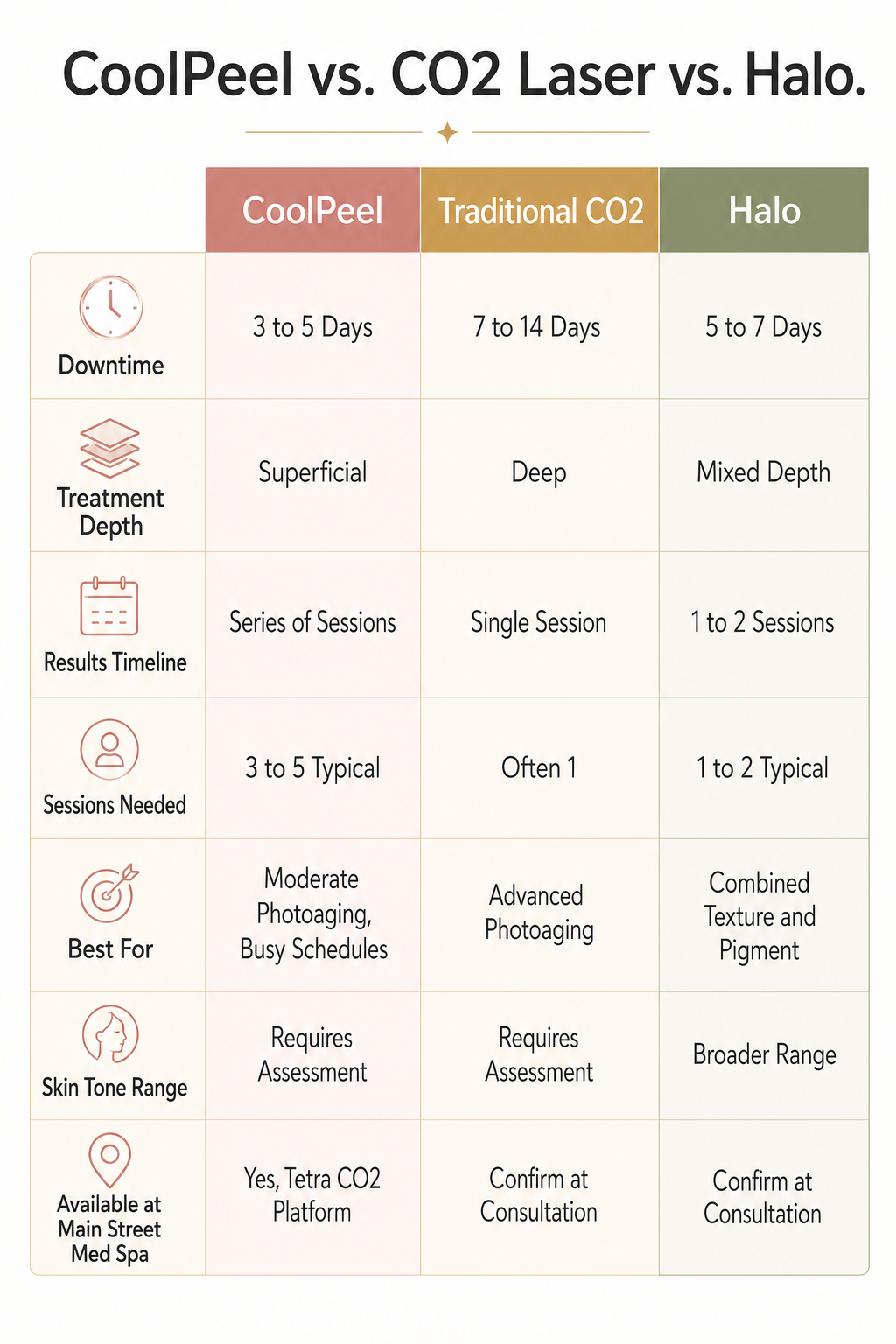
CoolPeel typically requires 3 to 5 days of recovery. Traditional ablative CO2 laser requires 7 to 14 days. Halo falls in the middle at roughly 5 to 7 days depending on the settings used. Those numbers are averages, and your own timeline depends on your skin and the settings chosen for you.
What Downtime Actually Looks Like Day by Day
With CoolPeel, most patients see redness and light swelling for the first day or two, followed by fine peeling that resolves by day four or five. Traditional CO2 involves more pronounced swelling, weeping, and a longer peeling phase that can stretch past a week. Halo sits between the two, with a shorter peeling window than full CO2 but longer than CoolPeel alone.
Social Downtime vs. Full Recovery, the Distinction That Matters
Social downtime is how long it takes before you feel comfortable being seen in public, while full recovery is how long the skin takes to completely heal. CoolPeel's social downtime is often just a few days. Traditional CO2 usually asks for a full week before most patients feel ready to skip makeup and go about their routine.
Which Treatment Produces the Most Dramatic Results?
Traditional ablative CO2 at full settings produces the most significant single session improvement, but it also asks for the most recovery. CoolPeel can approach similar results over a series of treatments, with much less intensity per session. Halo targets both pigmentation and texture in one pass, useful for patients dealing with both at once.
Think of it less as one laser being "better" and more as a trade between how much change you want at once and how much downtime you can accept. A CoolPeel series often achieves comparable results to a single aggressive CO2 pass, just spread across a few appointments instead of one.
Which Laser Is Best for Sun-Damaged Skin in Eastern New Mexico?
For patients with moderate photoaging, meaning sun spots, early texture changes, and mild lines, CoolPeel is typically the most practical choice. For more advanced photoaging, a traditional CO2 pass may be worth considering if the extra recovery is manageable. Living in this part of New Mexico means sun exposure adds up over the years, even for people who are careful about it.
For pigmentation that is more about tone than texture, an IPL photofacial is often recommended alongside either laser. If pigmentation is your main concern, our breakdown of how IPL compares to laser resurfacing for pigmentation walks through that decision.
Which Treatment Is Right for Your Skin Type and Tone?
CoolPeel and traditional CO2 require careful assessment for darker skin tones because of the risk of post-inflammatory hyperpigmentation. Halo's non-ablative wavelength generally has a broader skin tone range, though all three still require a clinical evaluation before anything is scheduled.
This is one of the areas where a consultation matters more than a comparison chart. Skin tone, not just skin concern, changes which laser is appropriate , and that assessment has to happen in person. If Halo and CoolPeel are both on your shortlist, our guide on how to decide between Halo and CoolPeel when both are available nearby goes deeper into that comparison.
What Does Main Street Med Spa Offer, and How Does Madison Choose?
Main Street Med Spa offers CoolPeel through the Tetra CO2 platform. During your consultation, Madison Alcaz, RN BSN, assesses your skin type, your concerns, and your available recovery time, then recommends the treatment, or combination of treatments, that will get you to your goal safely.
That assessment is personal, not a menu you pick from on your own. Your skin and your timeline shape the plan, which is why the same question can have a different answer for two different patients. You can read more about CoolPeel laser resurfacing at Main Street Med Spa and what the treatment involves.
Frequently Asked Questions About CoolPeel, CO2 Laser, and Halo Resurfacing
What is the difference between CoolPeel and CO2 laser?
CoolPeel is a delivery mode of a fractional CO2 laser that targets only the superficial skin layer, producing meaningful results with 3 to 5 days of downtime. Traditional ablative CO2 laser goes deeper for more dramatic single session results, but requires 7 to 14 days of recovery. CoolPeel is generally preferred by patients who want real improvement without stepping away from work for very long.
What is the difference between CoolPeel and Halo?
Halo is a hybrid fractional laser that delivers non-ablative and ablative wavelengths at the same time, targeting surface pigmentation and deeper tissue together. CoolPeel uses a single CO2 wavelength focused on the superficial layer. Halo has a slightly broader skin tone range in some cases. The better fit depends on your skin concerns and gets determined at consultation.
Which laser resurfacing treatment has the least downtime?
CoolPeel typically has the shortest recovery of the three, with most patients experiencing 3 to 5 days of redness and peeling. Halo averages 5 to 7 days. Traditional ablative CO2 at full settings requires 7 to 14 days. CoolPeel is often preferred by patients who cannot take extended time away from work.
Is CoolPeel or CO2 laser better for fine lines?
Both CoolPeel and traditional CO2 laser stimulate collagen production that improves fine lines over time. Traditional CO2 at higher settings can produce more dramatic improvement in one session for deeper lines. CoolPeel achieves comparable improvement through a series of treatments with less intensity per visit. The right choice depends on how deep your lines are and how much downtime you can accommodate.
Does Main Street Med Spa offer Halo laser in Clovis, NM?
Main Street Med Spa currently offers CoolPeel resurfacing through the Tetra CO2 platform. Treatment menus can change over time, so the most reliable way to confirm Halo availability, or to find out which current option suits similar goals, is to ask directly during your consultation.
Madison Alcaz's Perspective
"The comparison question I get most often is CoolPeel versus CO2, and my answer is always the same: it depends on what you are willing to go through to get there. Both can deliver excellent results. The difference is the path. Most of my patients in Clovis are working, raising kids, running a business. They cannot take two weeks off. A series of CoolPeel treatments gets them where they want to be without asking them to disappear for a week and a half."
- Madison Alcaz, RN BSN
Ready to Find Out Which Resurfacing Treatment Fits Your Skin?
Comparing CoolPeel, CO2 laser, and Halo online is a useful starting point, but the consultation is where the right answer for your skin actually gets determined. Charts can only tell you so much. Your skin tone, your concerns, and your schedule decide which laser makes sense.
Madison Alcaz, RN BSN, Main Street Med Spa's Concierge Injector, brings more than 10 years of experience and extensive training in aesthetics to every consultation, serving patients throughout Clovis, Portales, Texico, and the wider Eastern New Mexico region. Every recommendation starts with a personalized treatment plan built around your goals.