What Is Sculptra and How Is It Different from Traditional Dermal Fillers?
TL;DR
- Sculptra is a poly-L-lactic acid injectable that stimulates your body's own collagen production over several months rather than adding immediate volume like hyaluronic acid fillers do.
- Results build gradually and can last up to two years, making it one of the longest-lasting options for patients dealing with facial volume loss.
- It requires a treatment series, not a single session, and works best for patients willing to let results develop on a biological timeline.
Most patients who walk into Main Street Med Spa in Clovis aren't looking for a dramatic change. They're looking for a reason they no longer look like themselves. The cheeks are a little flatter. The folds around the mouth are deeper. The overall structure of the face feels less supported. That shift is almost always collagen loss, and it happens gradually enough that many people can't point to when it started.
Traditional hyaluronic acid fillers correct that deflation by placing volume directly where it's missing. Sculptra takes a different approach entirely. It signals the body to produce new collagen in the treated area, rebuilding the framework that held the face's structure in the first place. For patients in Clovis, Portales, and across Eastern New Mexico who are ready for a result that develops with their biology rather than on top of it, that difference is worth understanding fully.
What Is Sculptra and How Does It Work?
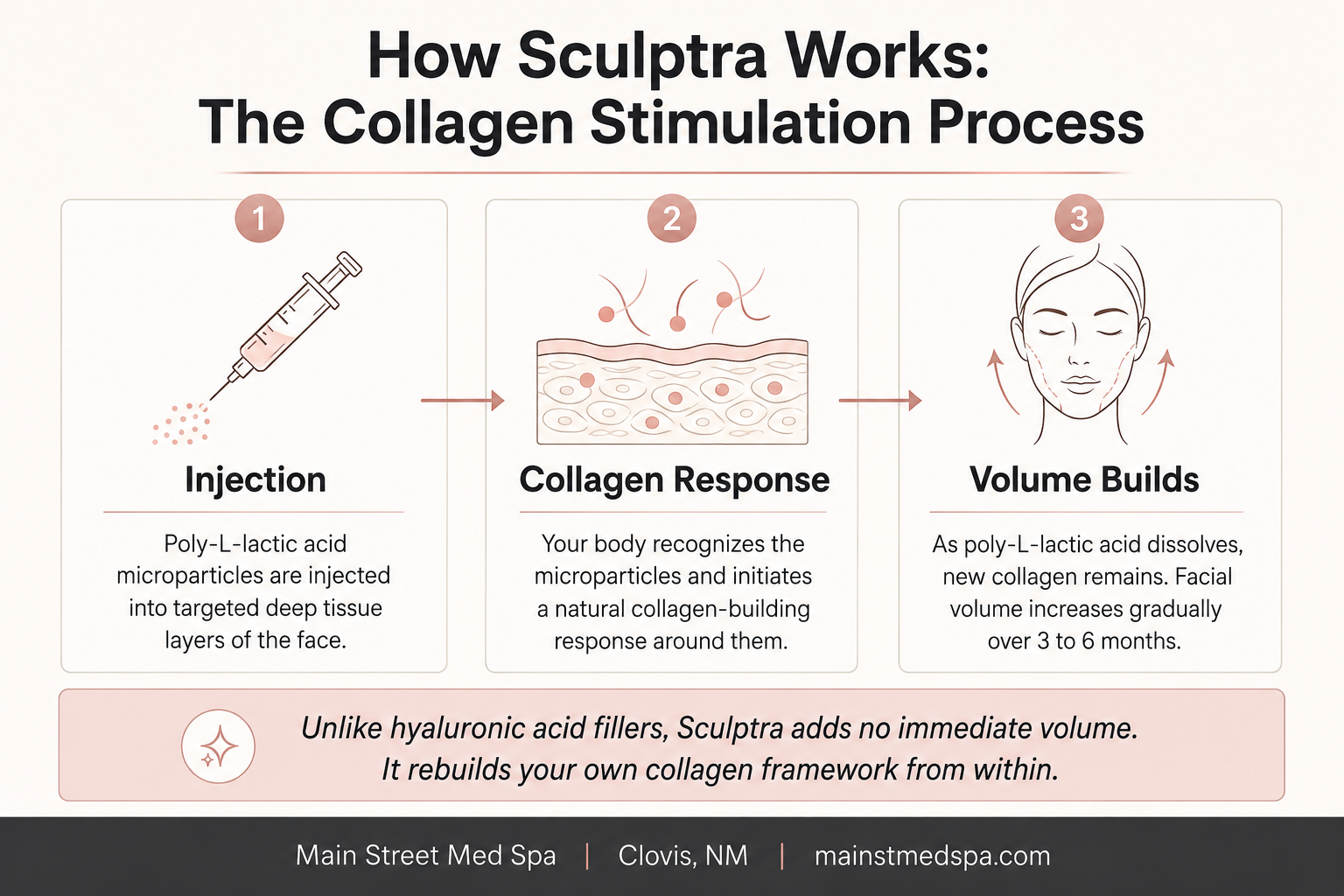
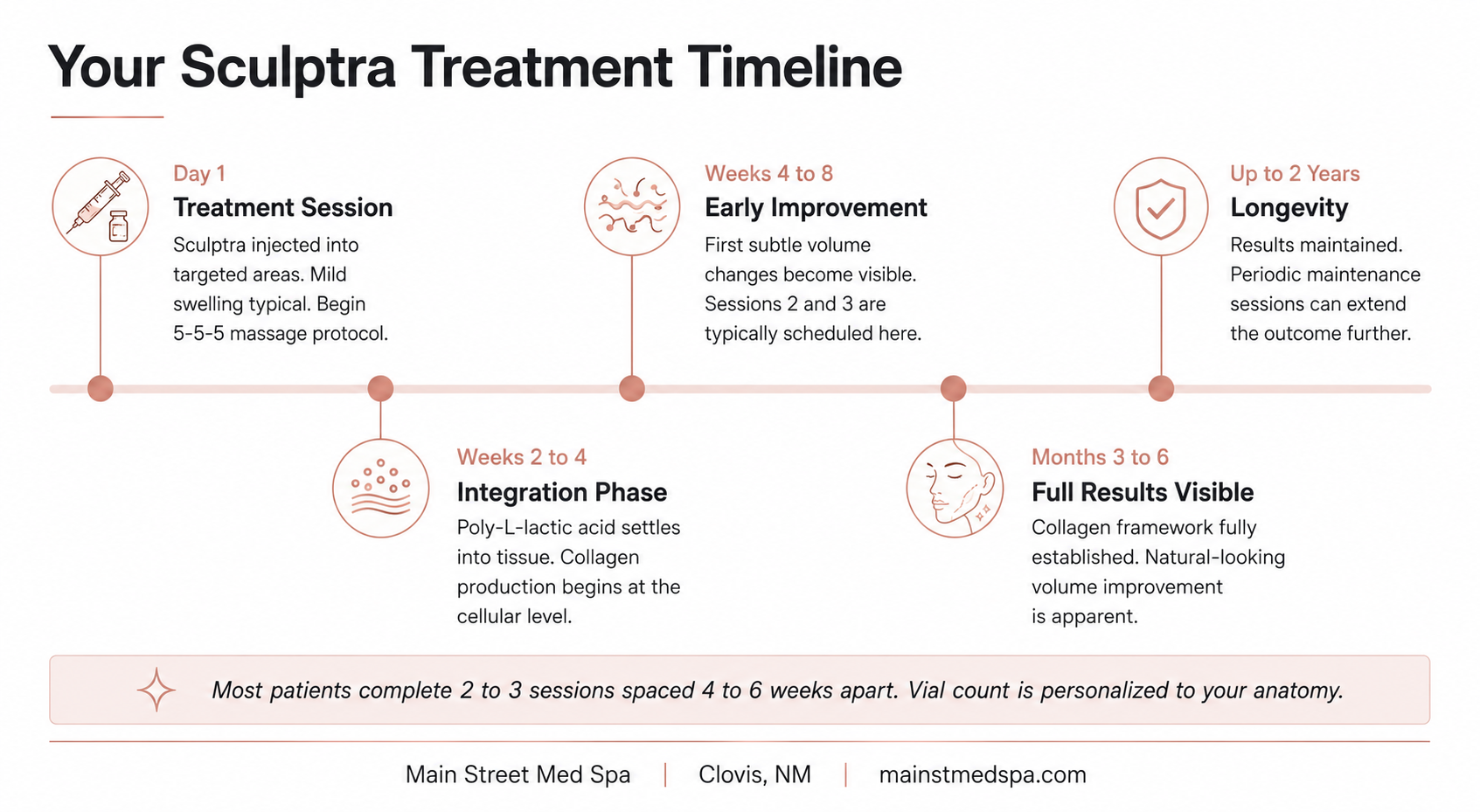
Sculptra contains poly-L-lactic acid microparticles that trigger a controlled collagen-building response in the deep tissue layers of the face. Results are not immediate. They develop over three to six months as the body produces new collagen around the treatment area, with the full outcome becoming visible well after the last session is complete.
Poly-L-lactic acid is a biocompatible synthetic material used in medicine for decades, including in dissolvable sutures. When injected into targeted areas of the face, it functions as a biological signal. The body recognizes the microparticles and initiates a collagen-producing response around them. As the poly-L-lactic acid dissolves over the following weeks, the new collagen it stimulated remains. Volume increases because the tissue has rebuilt itself, not because a gel is sitting underneath it.
The collagen stimulation process explained
After a Sculptra session, most patients see little visible change in the first two to four weeks. That is not a sign the treatment isn't working. The tissue-level response that drives collagen synthesis is already underway. Early volume improvements typically become noticeable between four and eight weeks. By three to six months post-treatment, the full result is visible and the collagen scaffolding is established.
This timeline requires patients to trust a process they can't see in real time. The payoff is a result that looks as though the aging simply reversed itself rather than being corrected from the outside.
Why results take time and why that's actually a benefit
When volume is added instantly, even by a skilled injector, there's a period of transition during which swelling, settling, and adjustment can be visible to people close to the patient. With Sculptra, the change happens on a biological schedule. By the time the full result is apparent, it has already been present long enough to look like the patient's own face. Friends and family notice the person looks well-rested or younger. They rarely notice a procedure.
What Does Sculptra Treat, and Where Does It Work Best?
Sculptra is most effective for restoring mid-face volume loss, softening deep nasolabial folds, rebuilding cheek contour, and improving the overall structural deflation that accumulates with age. It is not designed for fine surface lines, precise lip augmentation, or situations where immediate visible correction is the primary goal.
Best treatment areas for Sculptra
The areas where Sculptra consistently performs well are governed by volume rather than movement. The mid-face and cheeks see the most significant structural improvement. The temples, which hollow noticeably in many patients over 40, respond well to the collagen production Sculptra initiates. The jawline can also benefit when volume loss is contributing to laxity along that border.
Nasolabial folds are one of the most common concerns patients bring in. Sculptra approaches the fold by rebuilding the volume in the cheek above it rather than filling the fold line directly. For patients where significant mid-face deflation is driving the depth of the fold, this approach often produces more durable and natural correction than placing filler along the fold itself.
Where Sculptra is not the right choice
Sculptra is not appropriate for lip augmentation. It is not the right option when a patient needs visible results within days of a specific event. It does not address fine lines at the skin surface. For those goals, hyaluronic acid fillers remain the better tool. In many cases, Madison Alcaz, RN BSN, designs treatment plans that use Sculptra as a foundational collagen layer and pairs it with HA fillers for targeted precision work over time.
How Many Sculptra Sessions Does It Take?
Most patients complete a series of two to three treatment sessions spaced four to six weeks apart. The number of vials used per session is determined by the degree of volume loss and the areas being treated, not by a standard protocol applied to every patient.
Vial count varies meaningfully from one patient to the next. Someone in their late 30s with mild mid-face deflation may need fewer vials per session than a patient in their mid-50s with more significant global volume loss. During a full facial assessment at Main Street Med Spa, Madison maps the anatomy and builds a series based on what the patient's face actually needs.
Results from Sculptra are cumulative. Each session adds to the collagen produced in prior sessions. Patients who begin treatment earlier in the progression of volume loss typically need fewer vials total to achieve and maintain their result.
How Does Sculptra Compare to Traditional Hyaluronic Acid Fillers?
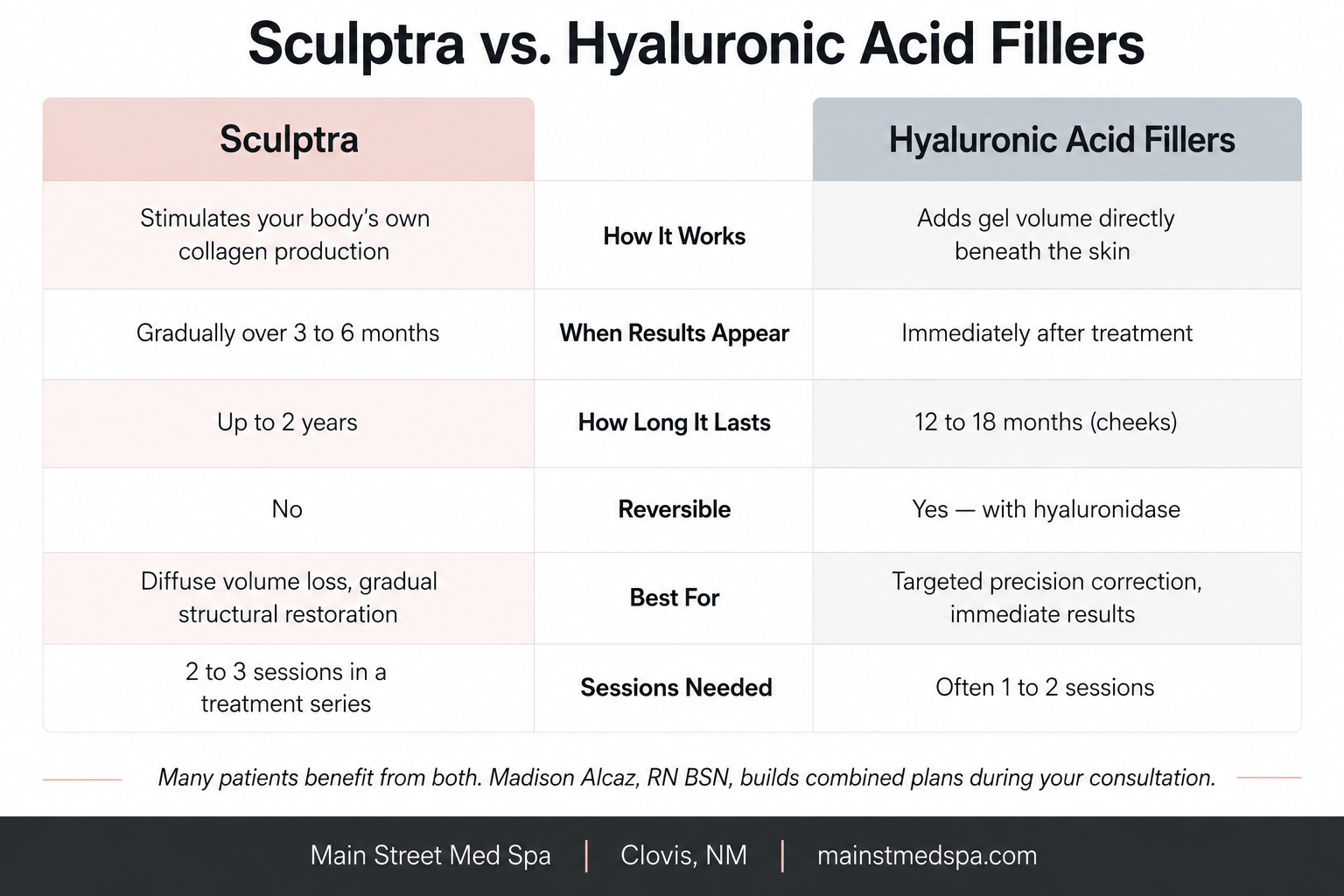
Hyaluronic acid fillers place gel volume directly beneath the skin and the result is visible the same day. Sculptra places nothing. It signals the body to produce its own collagen, and that collagen builds gradually over three to six months. The outcome looks different from a same-day filler result because it developed the way natural volume does.
Longevity is the other major distinction. Most HA cheek fillers last twelve to eighteen months before the body metabolizes the gel and volume begins to fade. Sculptra results can hold for up to two years, and because the collagen your body produced is real tissue, the transition back to baseline tends to be slower and more gradual than the drop-off patients sometimes notice with HA fillers.
Reversibility is worth understanding before choosing. HA fillers can be dissolved with hyaluronidase if a correction is needed. Sculptra cannot be reversed the same way. That is not a reason to avoid it, but it does make the consultation conversation more important. Patients need to come in with realistic expectations about the timeline and trust the process before the first session begins.
The two products are genuinely different tools built for different goals. HA fillers are the right answer when a patient wants immediate visible correction, needs flexibility, or is addressing a precise and localized area. Sculptra is the right answer when a patient wants a result that develops naturally, holds longer, and addresses the structural volume loss driving the aging they're seeing rather than correcting the surface expression of it.
Many patients use both over time. Sculptra builds the collagen foundation. HA fillers handle the targeted precision work on top of it. Madison Alcaz, RN BSN, maps out which approach fits a patient's anatomy and goals during the consultation, not based on a default preference.
For a closer look at one specific comparison, the article on
Sculptra or traditional fillers for nasolabial folds breaks down how each option performs for that particular concern.
What Is Recovery Like After Sculptra?
Recovery after Sculptra is generally mild. Localized swelling and bruising are the most common responses and typically resolve within a few days. The standard post-care protocol is the 5-5-5 rule: massage the treated area for five minutes, five times per day, for five days following each session.
That massage protocol serves a clinical purpose. It distributes the poly-L-lactic acid microparticles evenly through the tissue so the collagen response develops uniformly rather than concentrating in a single area. Patients who skip or shorten the massage can see uneven results. Madison reviews the full protocol at the end of every session and stays available to patients throughout the treatment series.
Swelling immediately after treatment can temporarily make the area look more corrected than it will once everything settles. Patients should not assess their results in the first week or two. The early swelling is not the collagen. The collagen comes later.
Who Is Sculptra Best Suited For?
Sculptra is ideal for patients in their late 30s to 60s who are experiencing gradual volume loss and deflation in the mid-face, prefer a natural and progressive result, and are committed to a treatment series rather than a single-session correction.
The patient who tends to get the most out of Sculptra is one who has noticed the face looking different but can't quite identify what changed. That quality of aging, where nothing looks dramatically wrong but everything looks a little less supported, is exactly what Sculptra is designed to address. The treatment rebuilds the structural layer that years of collagen loss have reduced.
It is not the right fit for someone who needs visible results before a specific event in the coming weeks, or for someone who is uncomfortable with a gradual process. For patients weighing their options before committing to either approach, the full breakdown of
how Sculptra compares to hyaluronic acid dermal fillers is a useful starting point.
Frequently Asked Questions About Sculptra
How long does Sculptra last?
Sculptra results typically last up to two years, making it one of the longest-lasting injectable options available. Because it works by stimulating your body's own collagen production rather than placing external volume, results develop gradually over three to six months and hold significantly longer than most hyaluronic acid fillers. Periodic maintenance sessions can extend the result beyond the two-year mark.
Which is better for nasolabial folds: Sculptra or traditional fillers?
It depends on what's driving the fold and what your timeline looks like. HA fillers provide immediate visible correction and are a good choice when speed matters. Sculptra works by rebuilding the mid-face volume that causes folds to deepen over time, addressing the source rather than the line itself. For patients with significant volume loss above the fold, Sculptra often produces more natural long-term correction. Madison Alcaz, RN BSN, evaluates both options during your consultation and recommends based on your actual anatomy.
How many Sculptra sessions will I need?
Most patients complete two to three sessions spaced four to six weeks apart. The total number of vials used across those sessions depends on your degree of volume loss and the areas being treated. Your personalized treatment series is outlined during your initial consultation at Main Street Med Spa before any treatment begins, so you know exactly what the plan involves.
Does Sculptra hurt?
Sculptra is mixed with lidocaine before injection, which significantly reduces discomfort during treatment. Most patients describe the sensation as mild pressure. Topical numbing is also available for sensitive areas. Discomfort during the session is brief and well-managed with proper preparation.
Can Sculptra be combined with other treatments?
Yes. Sculptra is frequently combined with HA fillers, Botox, and laser treatments as part of a broader rejuvenation plan. Because Sculptra builds volume gradually, it works well as a foundational layer that other treatments complement over time. Madison designs combined plans during your consultation based on your specific goals, not a default menu.
Madison Alcaz's Perspective on Sculptra
"I recommend Sculptra most often to patients who come in asking for a result that looks like they've taken very good care of themselves, not like they've had work done. Because the results build over months, by the time someone sees the full outcome, it reads as natural aging in reverse. That's exactly what the collagen rebuilding process is. The patience required is part of why the results look so good."
— Madison Alcaz, RN BSN, 10+ years in aesthetic medicine
Start Your Sculptra Consultation in Clovis
Sculptra's gradual timeline is part of what makes the result look the way it does. Patients who begin their series now will be seeing their best outcome in three to six months. The decision made today is the one that shapes how you look heading into the seasons ahead.
At Main Street Med Spa in Clovis, every Sculptra patient starts with a full facial assessment. Madison Alcaz, RN BSN, uses that assessment to identify which areas are driving the aging you're noticing, how many sessions your anatomy calls for, and whether Sculptra alone or Sculptra combined with other treatments gives you the result you're after. You leave the consultation with a clear, personalized treatment plan.
Serving patients from Clovis, Portales, Texico, Farewell, and across Eastern New Mexico. Madison Alcaz, RN BSN, Your Concierge Injector, with 10+ years in aesthetic medicine, is ready to walk you through it.