Which Is Better for Nasolabial Folds: Sculptra or Traditional Dermal Fillers?
TL;DR: Hyaluronic acid fillers correct nasolabial folds immediately and are reversible. Sculptra works more gradually, rebuilding the collagen scaffolding that causes folds to deepen in the first place, with results that can last up to two years. The right choice depends on how much mid-face volume loss you have and how quickly you want to see results.
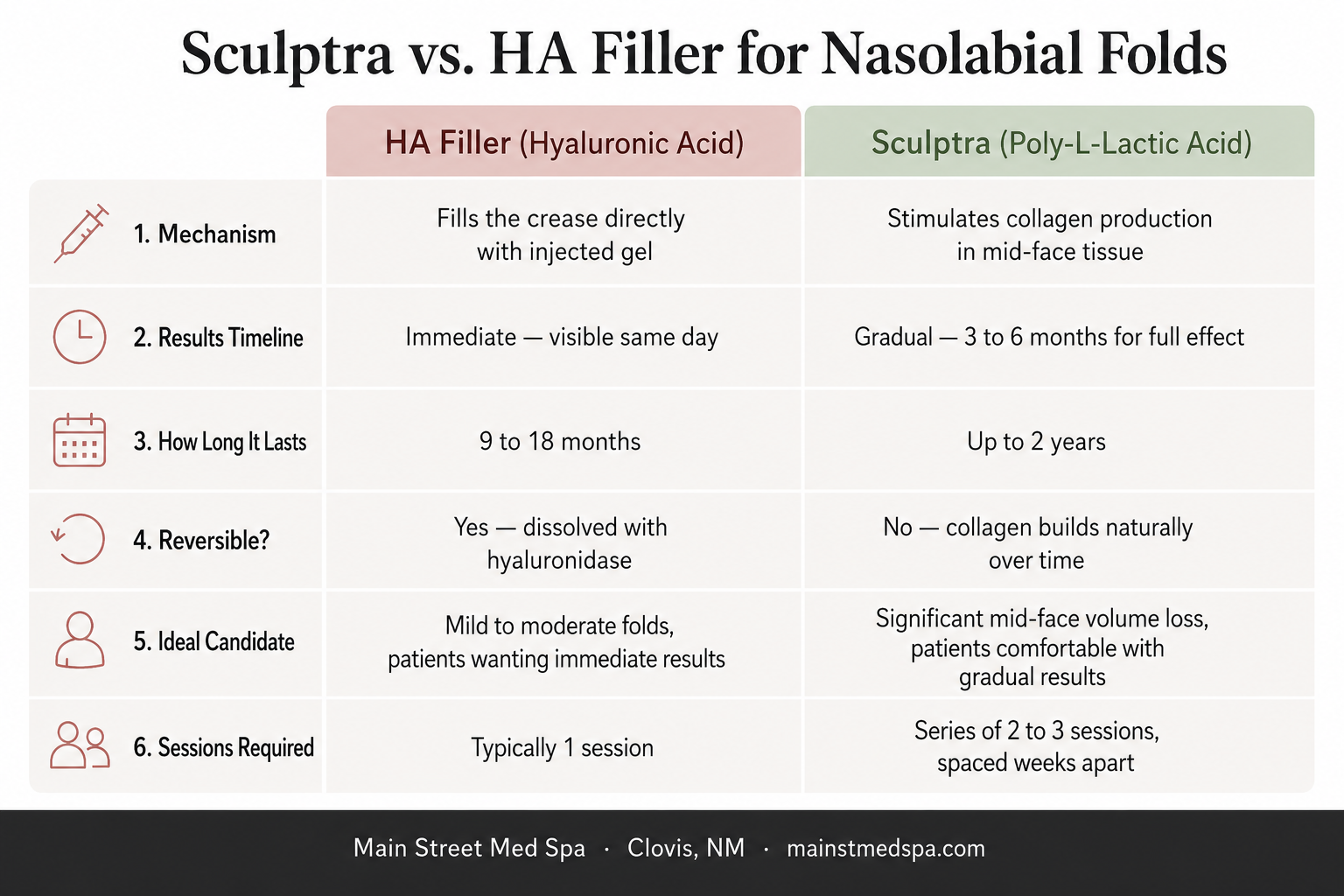
Nasolabial folds are one of the most common concerns patients bring to Main Street Med Spa in Clovis, New Mexico. The question of whether to use Sculptra or a traditional hyaluronic acid filler comes up in nearly every facial assessment. Both work. But they work differently, and understanding that difference changes the entire conversation.
How Do HA Fillers Actually Treat Nasolabial Folds?
Hyaluronic acid filler is injected directly into or alongside the nasolabial fold, adding volume that physically lifts and softens the crease. Results are visible the same day, with final assessment at two weeks once any swelling resolves.
The correction is real and often dramatic. Products like Juvederm Voluma and Restylane Lyft are commonly used in this area because of their lift capacity and smooth integration with facial tissue. Most patients in the Clovis area can expect results to last anywhere from 9 to 18 months before a touch-up is needed, depending on the product and how quickly their body metabolizes it.
The other significant advantage: HA fillers are reversible. If a patient is unhappy with the result, an enzyme called hyaluronidase can dissolve the filler. That safety net matters to a lot of first-time patients.
How Does Sculptra Treat Nasolabial Folds Differently?
Sculptra is not injected into the fold itself. That distinction is worth repeating because it surprises many patients.
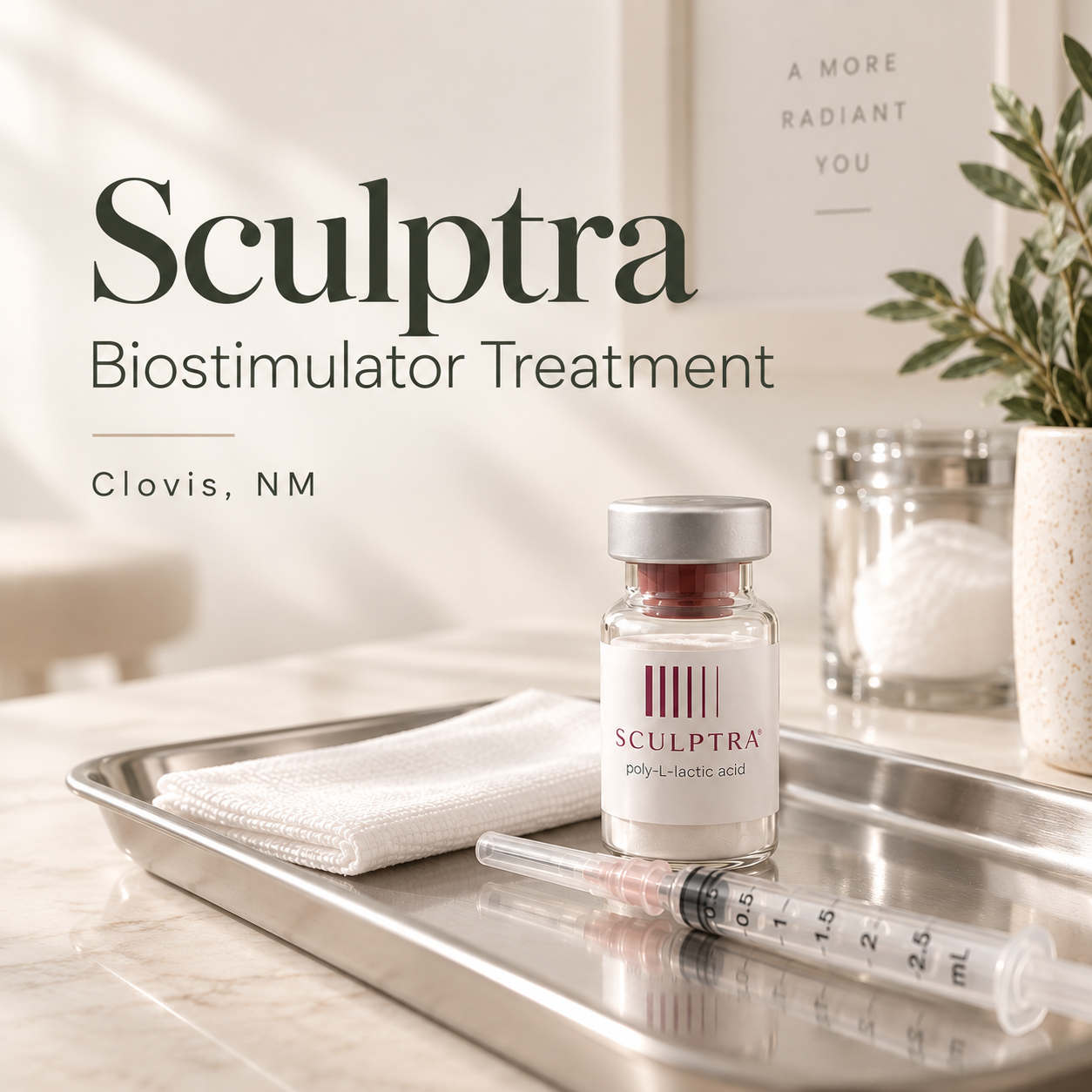
Sculptra (poly-L-lactic acid) is placed in the mid-face tissue, targeting the volume loss that is driving the fold's depth from above. Over 3 to 6 months, the microparticles stimulate your own collagen production, gradually rebuilding the facial scaffolding that volume loss has eroded. The fold softens as the tissue beneath it regains structure.
This is a biostimulator, not a filler. The correction builds slowly and, for most patients, looks completely natural because it is built from your own collagen. Results from a Sculptra treatment series typically last up to two years.
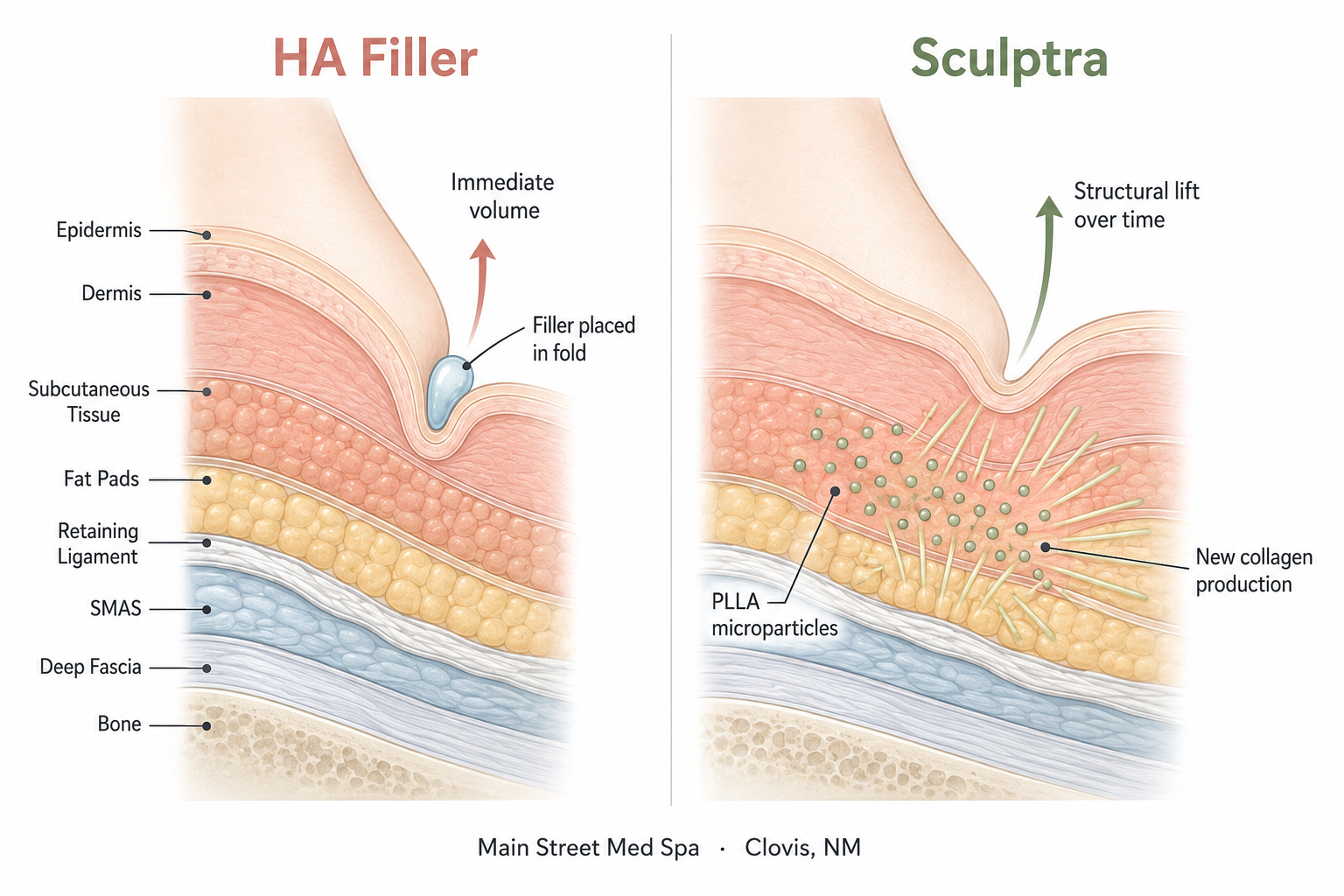
The tradeoff is time. Sculptra requires a series of treatments spaced several weeks apart, and visible results do not appear overnight. Patients who want immediate correction for an upcoming event are not good Sculptra candidates.
Which Produces Better Long-Term Results for Deep Nasolabial Folds?
For patients with significant mid-face volume loss driving deep folds, Sculptra often produces more natural long-term correction. It addresses the structural cause rather than filling the surface crease.
For mild to moderate folds, or for patients who want results quickly, HA filler is the more practical starting point. Some patients benefit from a combination approach: Sculptra for structural rebuilding and a small amount of HA filler for immediate improvement while the collagen response develops.
There is no universal answer here, which is exactly why a proper facial assessment matters.
Quick Questions
Does Sculptra actually work for nasolabial folds?
Yes. Sculptra is particularly effective when folds are driven by mid-face volume loss. By placing poly-L-lactic acid in the mid-face tissue rather than directly in the crease, Sculptra stimulates collagen production that lifts and softens the fold gradually over 3 to 6 months. It is not the right choice for patients who want same-day results.
How long does filler last in nasolabial folds?
Hyaluronic acid filler in the nasolabial folds typically lasts 9 to 18 months depending on the specific product and individual metabolism. Sculptra results in the same area can last up to two years, as the correction is built from your own collagen rather than an injected gel that breaks down over time.
How do I know which option is right for me?
The degree of volume loss, your timeline, and your personal goals all factor into the recommendation. "I look at nasolabial folds as a symptom of what's happening structurally above them," says Madison Alcaz, RN BSN. "For patients with significant mid-face deflation, Sculptra often makes more sense than trying to fill the fold itself." A full facial assessment at Main Street Med Spa evaluates both options based on your specific anatomy.
Ready to Find Out Which Treatment Fits Your Face?
For a complete breakdown of how Sculptra stimulates collagen for long-lasting nasolabial fold correction, read our full guide to how Sculptra stimulates collagen for long-lasting nasolabial fold correction.
When you're ready to move from research to a real recommendation, a personalized consultation with Madison Alcaz, RN BSN is where it starts. She evaluates your anatomy, your goals, and your timeline before recommending any product. There is no preference for one treatment over another, only what actually works best for your face.
Patients from Clovis, Portales, Texico, and the broader Eastern New Mexico region are welcome. Call or book online to get started.